Early Points Almost Always Lie
Why everyone — including me — decided the match was over too early

Hello,
A few of you have started replying to these pieces now, which is both flattering and mildly stressful. Anyway — here’s one I’ve wanted to write for a while.
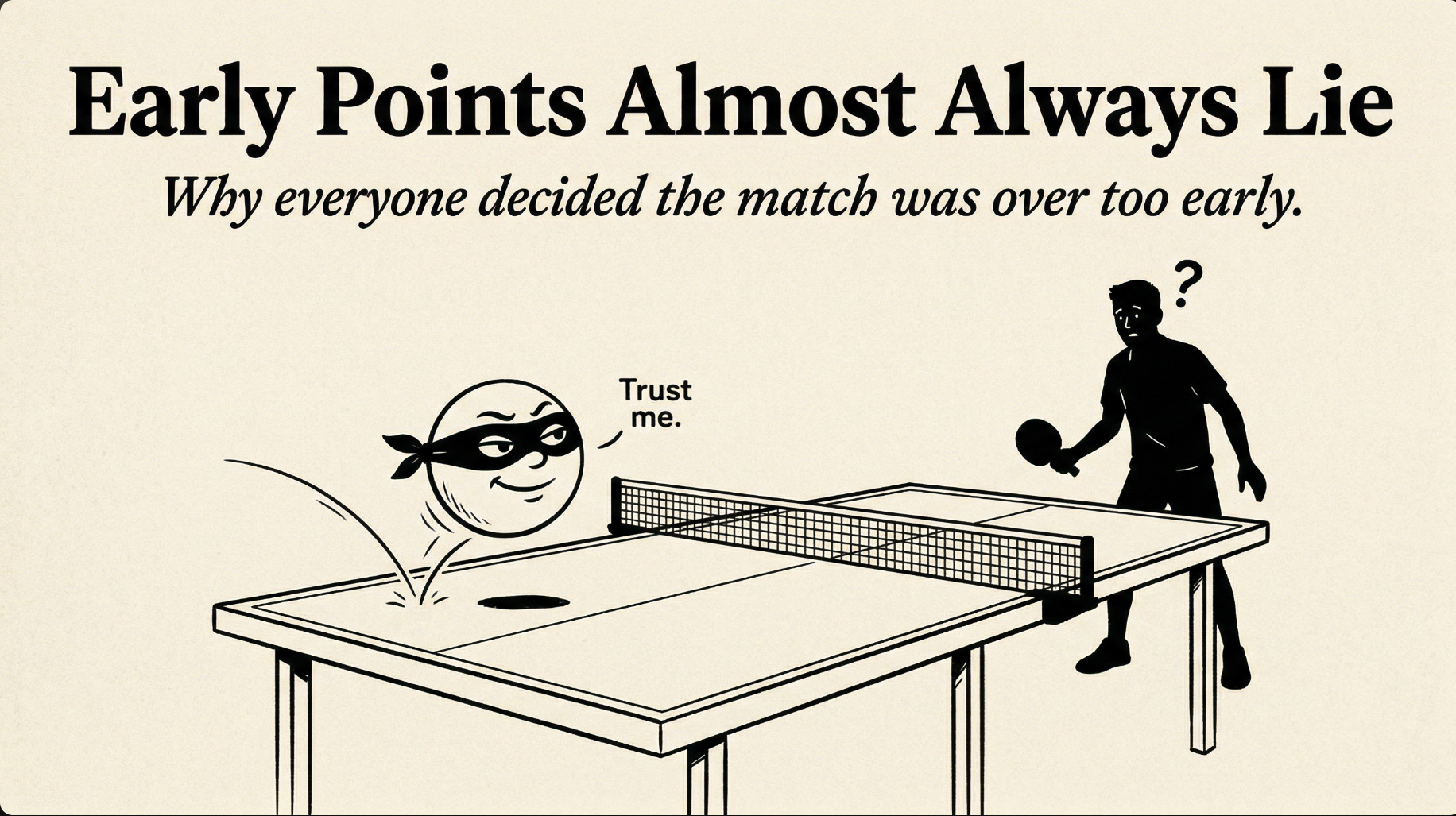
There’s a tournament in Pondicherry I still think about. Not because of what happened — but because of when everyone decided what was going to happen.
I lost the first three games. 11–4, 11–5, 11–7.
The guy was better than me. That wasn’t the surprise. The surprise was how quickly the match stopped being a match and became a formality.
My coach left to watch another student’s game. The people around the table thinned out. Even the referee had that energy — the “let’s wrap this up” body language you recognise when you’ve played enough tournaments.
And I wasn’t exactly fighting the narrative either.
I wasn’t thinking about a comeback. I was thinking about the scoreline. 4–0 was embarrassing. 4–1 would be respectable. 4–2, almost dignified. My ambition at that point was basically damage control.
Which, looking back, is a very funny mindset to have. Not “how do I win this.” Just “how do I lose this less badly.”
Then something shifted. Not in me — in him.
Game four. He started trying things. New serves. Casual variations. The kind of experiments you run when you’re already mentally at the canteen.
He was 3–0 up. Match was decided. So why not have some fun?
Except the experiments didn’t land.
I won that game 11–8. Not because I’d figured anything out. Just because he’d stopped taking it seriously and I hadn’t stopped trying to avoid a 4–0.
Very inspiring. Truly.
But game five was different. Somewhere between the fourth and fifth game, I started noticing things. Not big things — small ones. Where his serves were going. Which shots he was comfortable with. The patterns I’d been too panicked to see earlier.
Three games of information had been sitting right there. I just hadn’t been calm enough to use it.
Game five went my way. Then game six.
And now his body language changed.
This is the part I find most interesting. The journey from confident to overconfident to nervous — it happens fast, and it skips all the stops in between. There’s no gradual decline. One moment you’re experimenting because the match is won. The next moment you’re checking the score because suddenly it isn’t.
He went from treating the match like a practice session to realising it was a match again. And by then, the doubt had already settled in.
The decider was packed. Everyone who had left came back. The same people who’d mentally filed this as a 4–0 were now watching a seventh game in mild disbelief.
I won.
Threw my racket. Had a celebration that was probably excessive but felt entirely earned. Sat on the chair afterwards while the adrenaline did laps around my body, replaying points I couldn’t fully believe I’d played.
People came and congratulated me and I acted like I’d had a plan the whole time. I did not have a plan the whole time.
Here’s the thing though — this isn’t a comeback story. Or at least, that’s not why it stayed with me.
It stayed because everyone read the first three games as the match. Me included. Him included. The coach, the crowd, the referee — all of us looked at the same early information and decided it was a conclusion.
It wasn’t. It was just data.
This has happened enough times that I’ve stopped trusting early scores entirely. I’ve been up 3–0 and lost 4–3. I’ve been 5–0 up in a game and lost it 11–5. I’ve been down in situations that looked finished and watched them turn.
The first few points of a match tell you something. But they tell you a lot less than you think. And the moment you treat early information as a verdict — whether you’re ahead or behind — you’ve already started playing a different game.
Anyway — that’s this week’s thought.
See you next time,
Sabhya
Love this piece!
Thats a thought that I would continue to apply in Life… early wins are not a verdict
Goes back to the saying, “It’s not over till its over”
What a piece man, beautifully written